
California Inmate Search is a public service tool that allows individuals to locate adults currently held in California state prisons. The system is managed by the California Department of Corrections and Rehabilitation (CDCR) and provides verified, real-time data on inmate status, location, and key case details. This resource is essential for family members, legal representatives, law enforcement, and researchers who need accurate information about individuals serving sentences in state-level correctional facilities. It does not include data on inmates held in county jails, federal prisons, or juvenile detention centers. The search function is free, online, and available 24/7 through the official CDCR Inmate Locator website. Users can search using an inmate’s full name, partial name, or unique CDCR number. Results display critical identifiers such as current housing institution, admission date, projected release date, and offense classification. The tool is designed to support transparency, public safety, and legal accountability within California’s criminal justice system.
It is important to distinguish between state prisons and county jails when conducting a California Inmate Search. State prisons house individuals sentenced to more than one year for felony convictions, while county jails hold those awaiting trial, serving short sentences, or convicted of misdemeanors. Only inmates in CDCR-operated facilities appear in the statewide locator. For county jail inmates, searchers must contact individual sheriff’s departments directly, as no centralized database exists. The CDCR tool updates regularly but may lag by 48 to 72 hours for newly admitted or transferred inmates. Accuracy depends on timely data entry by correctional staff. Users should verify visitation eligibility, mailing addresses, and phone call procedures with the specific institution before making contact. This ensures compliance with facility rules and avoids rejected communications.
How to Use the Official CDCR Inmate Locator
The California Department of Corrections and Rehabilitation (CDCR) provides an official inmate information system for locating individuals incarcerated in California state prisons. This tool is the primary source for public inmate status at the state level and is updated regularly from internal CDCR records.
- To access the system, visit the official CDCR website:
- https://www.cdcr.ca.gov/
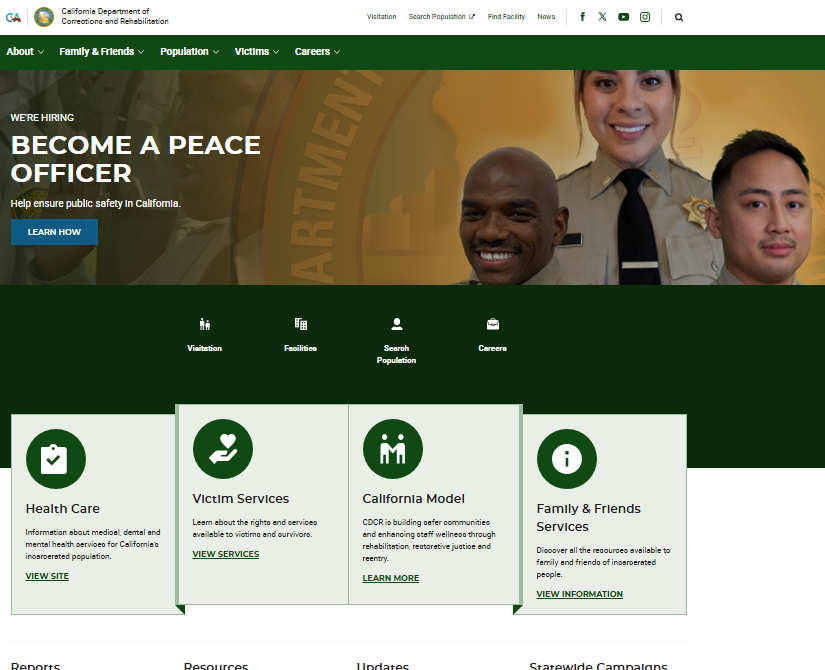
From the homepage, users can navigate to the Offender Information section and open the Inmate/Offender Search tool (Inmate Locator) through the official menu or site search. The system allows searches by name or CDCR number and is used for visitation, legal correspondence, and public record verification. It only includes individuals sentenced to state prison custody.
Step: Search Instructions
- Go to https://www.cdcr.ca.gov/
- Use the site search or menu to find Inmate Locator / Offender Search
- Enter the inmate’s last name in the search field
- Optionally add first name or initials to refine results
- Or enter the CDCR number for exact matching
- Click Search
The system will display matching records within seconds.
The Search Results
Search results typically include:
- CDCR Number: Unique inmate identifier
- Inmate Name: Full legal name
- Age: Based on CDCR records
- Current Location: Assigned prison facility
- Admission Date: Date of intake into CDCR custody
- Parole Eligibility Date: Earliest eligibility for parole
- Projected Release Date: Estimated release timeline
Searching for Inmates in County Jails
There is no statewide database for inmates held in California county jails. Each of the 58 counties operates its own jail system with independent record-keeping and public access policies. To locate someone in county custody, you must contact the sheriff’s department of the county where the individual was arrested or sentenced. This process requires knowing the general location of the crime or arrest. County jails typically hold people awaiting trial, serving sentences under one year, or convicted of misdemeanors. Unlike state prisons, these facilities do not participate in a centralized locator system. Some counties offer online inmate search tools, while others require phone calls or in-person visits. Always confirm the correct jurisdiction before initiating a search to avoid wasted time and effort.
How to Identify the Correct County
- Determine where the crime was committed or where the arrest occurred.
- Check the initial police report or court filing location—this usually indicates the responsible county.
- If the person lives in one county but was arrested in another, the arresting county controls jail placement.
- Use the California State Association of Counties website to find contact details for each sheriff’s office.
- Call the non-emergency line of the sheriff’s department and ask for the jail records unit.
County Jail Search Methods by Region
| County | Online Search? |
| Los Angeles | Yes – LA County Inmate Locator |
| San Diego | Yes – SD Sheriff Inmate Search |
| Orange | Yes – OC Inmate Locator |
| Riverside | Yes – Riverside Inmate Search |
| San Francisco | Yes – SF Sheriff Inmate Locator |
| Alameda | Yes – Alameda Inmate Search |
| Santa Clara | No – Call (408) 299-2611 |
| Fresno | No – Call (559) 600-1329 |
What Information Can Be Obtained?
- Full name and known aliases
- Booking date and time
- Charges filed (felony or misdemeanor)
- Bail amount and status
- Scheduled court dates
- Housing location within the jail
- Visitation eligibility and schedule
Using Inmate Data for Legal and Personal Purposes
California Inmate Search results serve multiple practical functions beyond basic location tracking. Legal professionals use the data to verify client status, prepare for hearings, or file motions. Family members rely on the system to plan visits, send mail, or arrange phone calls. Employers and landlords may conduct background checks using public records, though they must comply with Fair Credit Reporting Act guidelines. Researchers and journalists analyze aggregate data to study incarceration trends, recidivism, and sentencing patterns. The CDCR also publishes annual reports with demographic breakdowns, which support policy analysis and public safety planning. All uses must respect privacy laws and avoid harassment or misuse of personal information. The data is factual and publicly available, but ethical handling is essential.
Visitation and Communication Procedures
- Each prison has its own visitation rules—check the facility’s website before visiting.
- Visitors must be on the inmate’s approved list and present a valid photo ID.
- Mail must include the inmate’s full name, CDCR number, and facility address.
- Email and phone services are provided through third-party vendors like JPay or Securus.
- All incoming mail is inspected for contraband; packages require prior approval.
Legal and Background Check Applications
- Verify an individual’s incarceration status before hiring or leasing property.
- Confirm court appearance history for legal proceedings.
- Support parole board requests with documented behavior and program participation.
- Aid in victim notification under California’s Marsy’s Law provisions.
- Assist attorneys in preparing defense strategies based on the custody timeline.
Limitations on Data Use
- Juvenile records are confidential and not accessible via public search.
- Medical and mental health details are protected under HIPAA and not disclosed.
- Appeals and disciplinary records require formal Public Records Act requests.
- Employers cannot discriminate based solely on incarceration history under AB 1008.
The CDCR Inmate Records and Offense Classification
The CDCR maintains detailed records for every inmate in state custody. These records include personal identifiers, criminal history, sentencing details, program participation, and behavioral notes. The Inmate Locator provides a summary view, but full records require a formal request under the California Public Records Act. Offenses are classified by severity, with felonies divided into violent, non-violent, and sex-related categories. Sentence length depends on the crime, prior convictions, and enhancements under California’s Three Strikes Law. The system also tracks parole eligibility, work assignments, education progress, and medical care. This data supports rehabilitation efforts and public safety monitoring. Researchers can access aggregated statistics through the CDCR’s Offender Information Services Branch, which publishes annual reports on population trends, recidivism, and facility operations.
Types of Offenses and Sentence Lengths
| Offense Type | Example Crimes |
|---|---|
| Violent Felony | Murder, robbery, assault with a deadly weapon |
| Non-Violent Felony | Burglary, drug possession, fraud |
| Sex Offense | Child molestation, rape, lewd acts |
| Property Crime | Theft, burglary, vandalism, arson |
Parole and Release Mechanisms
- Parole eligibility is calculated based on sentence type and good behavior credits.
- Life sentences require a parole hearing after a minimum term (e.g., 25 years for second-degree murder).
- The Board of Parole Hearings conducts reviews and may grant or deny release.
- Parolees must comply with conditions such as drug testing, employment, and no-contact orders.
- Violations can result in a return to custody.
Rehabilitation and Program Participation
- Educational programs include GED, vocational training, and college courses.
- Substance abuse treatment is available through certified counselors.
- Mental health services include therapy and medication management.
- Work programs allow inmates to earn wages and reduce sentence time.
- Faith-based and life skills programs support reentry preparation.
Statistical Resources and Public Reports
The CDCR’s Offender Information Services Branch compiles and publishes extensive data on California’s prison population. These reports are used for budgeting, policy development, and public transparency. The annual “Population Reports” show inmate counts by gender, age, race, and offense type. Other publications include escape statistics, employee injuries, and parole outcomes. The California Department of Justice also releases crime data through the Criminal Justice Statistics Center. This includes arrest rates, clearance rates, and victimization surveys. The FBI’s Uniform Crime Reporting program provides national context. All these sources are free and accessible online. They support research, journalism, and community safety initiatives. Users should note that data may be delayed by several months due to processing times.
Key CDCR Statistical Reports
- Monthly Population Reports: Current inmate count by facility and classification.
- Demographic Characteristics: Breakdown by race, gender, age, and nationality.
- Recidivism Studies: Rates of re-arrest and re-incarceration within three years.
- Parole Outcomes: Success and failure rates for released inmates.
- Employee Safety Reports: Incidents of staff injury or assault.
Accessing Public Data Online
- Visit the CDCR Reports page: CDCR Offender Reports
- Select the report type (e.g., “Monthly Population” or “Recidivism”).
- Download the PDF or Excel file for the desired year.
- Use filters to analyze data by region, facility, or demographic group.
- Cross-reference with DOJ crime data at https://oag.ca.gov/crime
Limitations of Public Data
- Data may be 60–90 days out of date due to reporting cycles.
- Some sensitive information is redacted to protect privacy.
- County jail data is not included in CDCR reports.
- Definitions of crimes may vary between agencies.
| Official Contact | California Department of Corrections and Rehabilitation |
| Address | P.O. Box 942883, Sacramento, CA 94283-0001 |
| Phone | (916) 445-6711 |
| Hours | Monday–Friday, 8:00 AM – 5:00 PM (Pacific Time) |
(FAQs) About California Inmate Search
These frequently asked questions about the California Inmate Search are designed to help users understand how the CDCR Inmate Locator works, its limitations, and how to resolve common issues during a search. They cover key topics such as search requirements, missing results, data accuracy, and access to inmate records. This section helps users navigate the system more effectively and avoid common mistakes when looking up inmate information.
Can I search for an inmate using only a first name?
No, the CDCR Inmate Locator requires at least a last name to search. First names alone are not sufficient because many inmates share common first names, leading to inaccurate or excessive results. The system is designed to prioritize precision and reduce false matches. You may enter a first name or middle initial in addition to the last name to narrow the results, but the last name field cannot be left blank. If you only know a first name, try to obtain additional details such as a last name, CDCR number, or approximate age. Contacting the sheriff’s department of the county where the person was arrested may help if they are in the county jail. For state prison searches, always use the full legal name whenever possible. Partial last names are accepted, but spelling must be correct. Misspelled names will not return results. The system does not support phonetic or fuzzy matching.
Why can’t I find someone I know who is in prison?
There are several reasons why an inmate may not appear in the CDCR search results. First, the person might be held in a county jail, federal prison, or out-of-state facility, none of which are included in the CDCR database. Second, newly admitted inmates may not be processed into the system for 48 to 72 hours. Third, the inmate may have been recently transferred between facilities, and the location data has not yet updated. Fourth, the name or CDCR number entered may be misspelled or outdated. Always double-check spelling and try alternative name formats. If the person was sentenced to less than one year, they are likely in county custody. Contact the local sheriff’s office for jail records. If the individual is on parole or has been released, they will no longer appear in the active inmate locator. For recently released inmates, check the CDCR’s parolee search tool or contact the Board of Parole Hearings.
How often is the inmate locator database updated?
The CDCR Inmate Locator is updated daily, typically overnight, to reflect changes in inmate status, location, and sentence calculations. However, real-time accuracy is not guaranteed. New admissions, transfers, releases, and court updates may take up to 72 hours to appear in the system. This delay is due to manual data entry and verification processes at each facility. The CDCR advises users to contact the institution directly for the most current information, especially before planning a visit or sending mail. System maintenance may also cause temporary outages or delays. The update schedule is not publicly disclosed, but historical data shows consistent nightly refreshes. Users should not rely solely on the locator for time-sensitive decisions. For legal matters, always request official records through the Public Records Act. The database reflects only state prison inmates and excludes those in local, federal, or juvenile custody.
Can I get medical or disciplinary records through the inmate search?
No, the CDCR Inmate Locator does not provide medical, disciplinary, or psychological records. These details are protected under privacy laws, including HIPAA and California’s Confidentiality of Medical Information Act. Only authorized personnel, legal representatives with proper documentation, or the inmate themselves can access such records. To request medical or disciplinary files, submit a formal Public Records Act request to the CDCR’s Office of Public Affairs. Include the inmate’s full name, CDCR number, and specific records sought. Processing may take 10 to 30 days, and some information may be redacted. Disciplinary records related to appeals or grievances require additional court orders. Family members cannot obtain these records without written consent from the inmate. The locator only shows basic identifiers like name, number, location, and release dates. For health-related inquiries, contact the facility’s medical unit directly, but be prepared to provide proof of relationship or legal authority.
What should I do if I find incorrect information in the search results?
If you notice inaccurate data in the CDCR Inmate Locator—such as a wrong name, outdated location, or incorrect release date—report it immediately to the CDCR. Contact the Public Information Office at (916) 445-4950 or email publicaffairs@cdcr.ca.gov. Provide the inmate’s CDCR number, the incorrect information, and the correct details if known. Include your name and contact information for follow-up. The CDCR will investigate and correct errors during the next data update cycle. Do not attempt to correct the record yourself. Errors may stem from data entry mistakes, delayed transfers, or court order processing lags. For urgent issues, such as a mistaken release date affecting legal proceedings, request a priority review. Keep records of all communications. If the error involves a county jail inmate, contact the sheriff’s records unit directly. The CDCR cannot correct non-state facility data. Always verify critical information with the institution before taking action.